Conversation Collapses Disagreement
Conversational AI narrows judgement by compressing disagreement into a single voice. It does this even when disagreement is the only honest state.
The common response is to reassure users that nothing fundamental has changed. People have always cherry-picked sources. Search engines already enabled confirmation bias. Conversational systems are merely faster. This line of reasoning fails because it treats conversation as a neutral wrapper around information. It is not. Conversation is a format that resolves tension by design. It produces coherence, not contrast.
Search required work - Conversation offers settlement
Under search, disagreement was visible by default. Competing sources sat side by side. Even a biased user had to navigate fragments, rankings, and gaps. The act of synthesis was unavoidable. Conversational systems invert that structure. They return a single, fluent response shaped to the framing of the question. Alternative interpretations do not appear unless explicitly requested, and even then they are often reconciled into a balanced summary that feels complete.
This matters because disagreement performs a cognitive function. It delays closure - It forces evaluation. When multiple claims coexist without resolution, the mind remains engaged. Conversational outputs remove that tension early and they do not argue they settle.
A high-stakes individual judgement shows the effect plainly. A clinician asks a conversational system for a summary of treatment options for a complex case. The response lists considerations in measured language and arrives at a cautious recommendation. The clinician reads it as an integrated view rather than as one possible framing among many. The absence of visible dissent reduces the felt need to consult colleagues or guidelines. The answer sounds like consensus, even where none exists.
Consensus without confrontation is a fiction
The same compression operates in organisational settings. A strategy team requests a synthesis of market risks for an internal paper. The generated text blends optimistic and cautious signals into a smooth narrative. During review, team members comment on tone and clarity, not on missing counter-arguments. By the time the document reaches leadership, the range of plausible futures has already been narrowed. The disagreement that should have structured the discussion never appears.
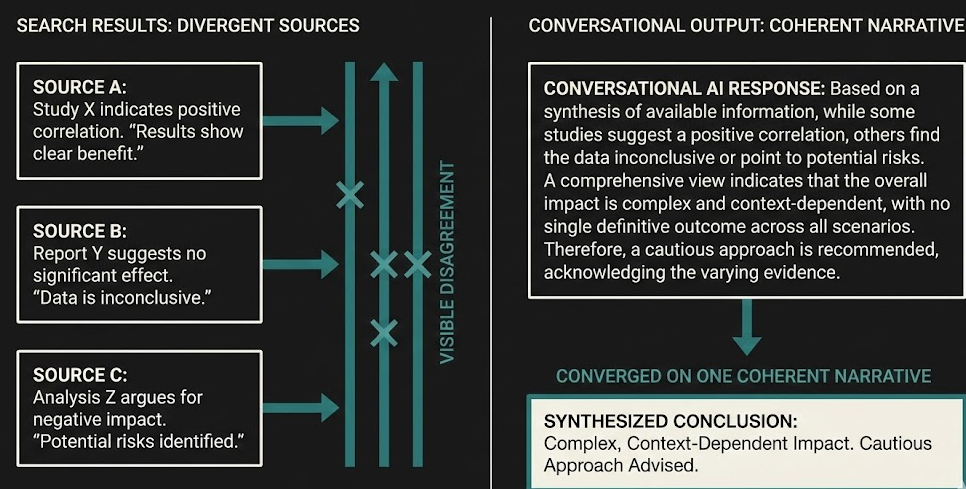
Figure 1 — Search versus conversation as epistemic formats
This compression is not malicious - It reflects optimisation choices. Language models are trained to produce helpful, readable continuations of text. Disagreement is costly in that objective. It fragments responses. It invites follow-up questions. It prolongs interaction. Coherence, by contrast, looks like success.
The human mind cooperates readily. Faced with a complete answer, people infer that the relevant considerations have been accounted for. The work of asking who disagrees, and why, feels optional rather than necessary. Over time, that habit reshapes how questions are posed. Users learn to ask for conclusions, not for conflicts.
There is a subtle learning effect here. Exposure to settled narratives trains users to expect resolution. Ambiguity begins to feel like a failure rather than a property of the problem. This expectation feeds back into institutions that already struggle to hold uncertainty. Reports, assessments, and policies drift toward premature synthesis because it is easier to circulate a single story than to defend a contested one.
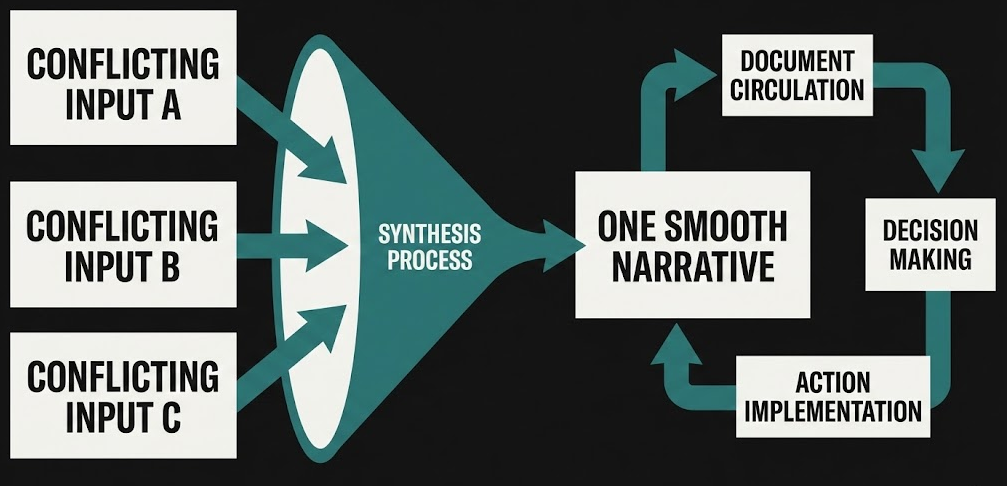
Figure 2 — Compression of disagreement through synthesis and reuse
This does not imply that disagreement must always dominate. Some tasks genuinely require consolidation. The problem arises when consolidation occurs before disagreement has done its work. Conversational systems accelerate that transition. They make synthesis feel like the first step rather than the last.
Calls for users to ask better questions underestimate the pull of the format. Even careful professionals default to conversation when time is scarce. The interface invites settlement. It does not insist on contestation.
If judgement is to remain robust, disagreement has to be preserved as a visible stage rather than treated as noise to be smoothed away. That preservation cannot rely on individual discipline alone. It must be built into how answers are produced, reviewed, and reused.
Conversational AI does not eliminate dissent. It hides it well enough that people stop looking.